Mar 28, 2013

Brief Reflection on Maundy Thursday and Love


In light of my recent post on Christian leadership, I decided that today is an appropriate day to again reflect on the how the church behaves differently than the world. On the church's calendar, today is Maundy Thursday. This day derives its name from the Latin word that is the root of our word mandate. It's called this because of Jesus' words in John, "a new command I give to you" or a new "mandate." This mandate comes after his washing of the disciples feet. Jesus is displaying that his style of leadership is built on love and service, not on power. With this "new mandate," Jesus instructs his disciples to do the same to one another and then says that this is how the world will know that they are his disciples, by their love (John 13:34-35)

The love that Jesus speaks of here is not a feeling, but a lifestyle of putting others before yourself and treating others as you would want to be treated. This is love that Jesus shows us by laying down his life on the cross. This is love is more than just a singular action or a feeling, it is a virtue or a "a certain quality of character" as C.S. Lewis describes virtue in Mere Christianity. Our God is love, it is a part of his nature, and here Jesus commands us to make love apart of our character as well. So, while we typically spend this week think about what Jesus did for the world, today we are reminded of what He has asked us to do as well. We are to make love one of our defining characteristics like Christ did. As Paul wrote in Colossians 3, we are to clothe ourselves with love which binds all other virtues together in perfect unity.

“As the Father has loved me, so have I loved you. Now remain in my love. If you keep my commands, you will remain in my love, just as I have kept my Father’s commands and remain in his love. I have told you this so that my joy may be in you and that your joy may be complete. My command is this: Love each other as I have loved you. Greater love has no one than this: to lay down one’s life for one’s friends." (John 15:9-13 NIV)

Mar 14, 2013

Thoughts on the new Pope and Christian Leadership

I'm not a Catholic, but like most have kept up with what's happening over in the Vatican. I watched as Benedict left for the last time as the Pope, and followed the announcement of the new Pope yesterday. In all of this, I have watched and shook my head as the American media has tried to understand what it means to be a leader in the church. They have talked about the power that the pope has in the world and speculated (quite a lot) about whether or not they would elect an American. Listening to the news, it all began to sound like election time in America. They were asking who was qualified, what kind of changes would this person make, and did they have the right leadership skills to be the Pope. It was all primarily about the power and position of the papacy.

Then yesterday, the church and the new pope did something that messed with the media's perception of "power" in the church. They elected someone that no one in the media considered and he choose a name that truly demonstrated what Christian leadership is all about. They elected man who has served the poor and chose to forgo some of the privileges that his previous role allowed him. They elected a man who is known for his act of washing the feet of 12 AIDS patients in 2001. Then they announced the name of the new pope. His name is Francis. He took the name of a very famous saint who is famously humble. Saint Francis chose a life of poverty and spent his life serving the poor and preaching the gospel. Of all the names he could have chosen, I think that this name is quite appropriate for someone who is supposed to lead the church. When it comes to being a leader in the church, it's not about power or wealth. It's not about having the most impressive resume or being the smartest guy around. It's not about being able to dominate the boardroom or be at the top of your field. It's about being like Christ.  Jesus Christ, "Who, being in very nature God, did not consider equality with God something to be used to his own advantage; rather, he made himself nothing by taking the very nature of a servant, being made in human likeness. And being found in appearance as a man, he humbled himself
by becoming obedient to death—even death on a cross!" (Phil 2:6-8 NIV)

While I'm not a catholic, I am impressed with the new pope's choice of name and I hope that he lives up to it. I hope that he emulates the life of Francis and the life of Christ. I hope that he leads in humility and shows the world that Christian leadership is different from political leadership. He is a man with a lot of influence, and I pray that his influence spreads the gospel and shows the love of Christ to those in need.

"Religion that God our Father accepts as pure and faultless is this: to look after orphans and widows in their distress and to keep oneself from being polluted by the world." (James 1:27 NIV)

For more about on this subject please check out my friend David's post, "The new Pope and why Protestants should care."

Mar 11, 2013

fighting the idols in our lives

If I asked you which of the Ten Commandments gave you the most trouble, you probably would admit to the second commandment. In Exodus 20:4 God commands, "You shall not make for yourself an image in the form of anything in heaven above or on the earth beneath or in the waters below." I don't think that this is a common problem in America today. I very rarely, if ever, see actual idols that were made to worship. There is, however, still an idolatry problem in our world today. Kyle Idleman meets this problem head on in his new book gods at war. He argues that while we aren't setting up statues or other images and bowing down to them, we're elevating people, ideas, and objects in our lives to a place higher than God. Idleman writes, "Anything at all can become an idol once it becomes a substitute for God in our lives." Whenever we make a choice that goes against God or favors someone or something over God, we have become idolaters.

gods at war is broken down into four sections. The first section defines what he means by idolatry. Idleman describes how we are in a battle with the "gods" of this world. These gods are fighting for our attention and drawing us away from Christ. The idols are not the same anymore. Unlike the Israelites who were following after Baal, Ashteroth, and Molech, we worship the gods of pleasure, power, and love. Essentially, though, we are doing the exact same thing as the Israelites. Instead of following God and pursuing obedience to him, we give our obedience and worship to something other than god. Worshipping Baal has the same consequence as worshiping love. The last three sections explore the ways we worship in the "temples" of power, pleasure, and love. Idleman explores how we devote ourselves to gods like money, success, food, entertainment, romance, and even family. Each of chapter in these sections (except for the last one) ends with questions to help the reader identify the idols that may be in their life.

I really appreciate what Kyle Idleman has done in gods at war. When I wrote my thesis on faith, I came to the same basic conclusions about where we put our faith. Ultimately if we are not trusting and seeking after God with our lives, then we have given something that isn't God the position of God in our hearts. I think a lot of people need to hear this today. The subject matter, however, is very similar to Timothy Keller's book Counterfeit Gods. If you've read Keller's book, this book is not going to much different. One thing Idleman does different is his book does a great job of helping you reevaluate the values you are giving to different people and things in your life. The reflective questions that appear in the book help you take this step. I don't think most of us realize how we have let something that might be good turn into a false god and rule over our lives. It does not, however, explore in depth in any one of the false god's that it discusses. For that reason, I believe this book would be best used in a group study since it comes with questions already imbedded in the text. Going through this book with a small group would allow someone to analyze each "god"a little more in depth (there are also online resources at godsatwar.com).

Disclosure of Material Connection: I received this book free from Zondervan as part of the BookSneeze.com book review bloggers program. I was not required to write a positive review. The opinions I have expressed are my own. I am disclosing this in accordance with the Federal Trade Commission’s 16 CFR, Part 255 : “Guides Concerning the Use of Endorsements and Testimonials in Advertising.”

Mar 4, 2013

The Dangerous Calling of Ministry

The call to full-time ministry is a dangerous call. For some it is dangerous in the sense of outward persecution, but for most who will read Paul David Tripp's book the danger is spiritual. Speaking from personal experience and from his experience counseling other pastors, Tripp describes the hazards encountered in full-time ministry. He shares how he has suffered and seen others suffer from the perils of personal sin, pride, burnout, and mediocrity. At the heart of all of it, however, is a failure by ministers to sit under their own teaching and to take to heart the scripture they spend so much time studying. We can become so good at studying and teaching about scripture and about spiritual disciplines, that we rarely spend time applying scripture to our lives and practicing Spiritual disciplines. There many points of application that readers can take away from Dangerous Calling, but  I believe this is one of the the most important points to remember. I don't think that most ministers would admit to thinking that they're above their own teaching, but it is very easy to live like it. I know personally I enjoy studying and reading about scripture and get so caught up in the act of studying and learning that I sometimes fail to worship the God I meet in scripture or practice what I learned.

Along with sitting under your own teaching, Tripp also reminds ministers to remember whose glory we are seeking in ministry. We are not seeking our own glory. Everyone in the church, ministers included, should be seeking the glory of God and avoiding self-glory. When we recognize that we are aiming to glorify God, we recognize that we are all sinners saved by grace, even seminary grads.  Last May, I graduated from Seminary and received my M.A. in Christian Education. I love my education and thankfully my professors seek teach more than knowledge. They taught us not only to study but to serve and worship God. I'm now pursing full-time ministry and am very thankful that I came across some recommendations for prospective ministers from bloggingtheologically.com. The first book was Dangerous Calling, and I'm glad I read it. It's a good reminder for someone like me who is going into ministry that even though I have received a seminary education I am not above it all.

If you're going into ministry, you should read this book. If you're in ministry, you should read this book. If you are close to someone in ministry who is having difficulties, you should read this book. If you're an elder at a church, you should read this book. This book doesn't cover every problem that a minster might have, but it serves as a good reminder for anyone connected to ministry or serving in ministry. It can be dangerous to be in ministry if you neglect yourself and forget whom you are serving.

I went to the library and got this book based on the recommendation from bloggingtheologically.com. I wasn't asked to write a review, but my wife says that I should write more book reviews. You should go to your library and get books, libraries are wonderful.

Feb 5, 2013

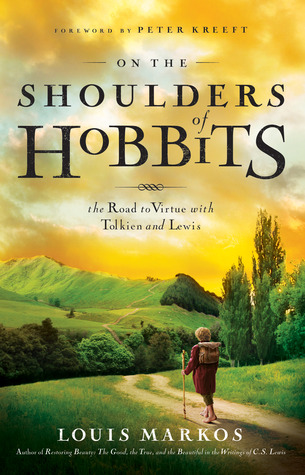
Exploring the Virtues in Tolkien and Lewis

Both J.R.R. Tolkien and C.S. Lewis were godly men and their writing was informed by their faith. Although not always evident to everyone or plain in all of their stories, they crafted their characters and worlds to reveal the virtues of the Christian life. It is more obvious in the work of Lewis, whose fiction works clearly represent Biblical stories and virtues. Tolkien's work is more often praised for the depth of the fantasy world that he created. Unfortunately, many have chosen to obsess over the characters and the world itself and not examine the virtue, or lack thereof, built into his characters. In his book On the Shoulders of Hobbits, Louis Markos examines the virtues behind the stories and characters. He shows how the faith of Tolkien and Lewis undergird the stories of Middle-Earth and Narnia. Markos divides his book into four main sections with four chapters each. The four main sections are the Road, the Classical Virtues, the Theological Virtues, and Evil. In each chapter, he primarily discusses how The Lord of the Rings, The Hobbit, and The Chronicles of Narnia portray the particular virtue or, in the case of evil, the lack of virtue.
Markos begins with the Road. While itself is not a virtue, this is an appropriate place to start when discussing the virtues in the world of story. All good stories begin with a hero being swept up into some sort of journey. This is especially true of Tolkien's works (he even wrote a poem about the Road). The Hobbit and The Lord of the Rings begin with a hobbit (or hobbits) leaving their shire on a journey. Markos rightly explains that all of us are called to take to the road and live out some sort of journey. Although our journey may not be as life threatening as those the Lewis and Tolkien write about, we all have to answer the call to live out the journey set before us.

The heart and meat of this book is found in parts two, three, and four. In sections two and three, Markos expounds how the seven virtues, four cardinal and three theological, are found in the work of Tolkien and Lewis. In the cardinal virtues, Markos does a fantastic job of revealing the characteristics of various characters in Middle-Earth and Narnia and the virtues that they portray. I particularly enjoy his exploration of wisdom and how wisdom and knowledge are not one in the same. Markos shows the differences between the wisdom and discernment of Gandalf and Saruman's quest for knowledge and power. He explains that Saruman's quest for power gives him great knowledge of evil and he gains great power, but Saruman's quest is ultimately folly because he quest for power blinds him to the fact that he is merely a pawn of Sauron. Gandalf, however, understands the wisdom of destroying the ring and not trying to better understand it and wield its power. 

The next part focuses on the three theological virtues of faith, hope, and love. Markos adds to this list friendship. This is, on one hand understandable, because of key role that friendship plays in Lord of the Rings and in many of the Narnia tales. On the other hand, it seems a bit odd that Markos seeks to add to the theological virtues. Looking at the table of contents, it appears that he was merely seeking for symmetry in his four sections to have four chapters. That being said, it is a well written chapter on the importance of friendship both in the lives of the authors and their works. Following friendship, he discusses faith, hope, and love. Compared to the section on the cardinal virtues, this is the weaker of the two discussions of the virtues. Primarily, I was disappointed with his section on faith. Instead of discussion the deep trust in faith that requires, primarily focuses on the meaning of the Greek word Kairos and how the council of Eldrond was a "Kairos" moment that called the characters to faith. 

Finally, Markos finishes with a discussion of evil, which might seem a little out of place, but fits in perfectly to round off this discussion. Not surprisingly, Lewis and Tolkien show a similar understanding of the nature of evil in the world. Neither of them consider evil or any evil power capable of creating anything. They are merely twisting and warping that which is good into evil. Markos explains that the "opposites" of the virtues, are not really opposites. Evil only has the power to steal, kill, and destroy what is good, it has no creative power. This is important in the real world because we need to see that God is the source of life and is more powerful that evil. It takes what God has created and twists, warps, and destroys. What may seem powerful to us, ultimately has no power over the Creator. The vices are not the opposite of the virtues, but merely a twisting of them.

Normally, I don't write reviews this long, but I am very pleased with this book and enjoy talking about this subject. Even though I have offered a few critiques, I believe that this is a fantastic book and a must read for anyone wanting to delve deeper into the writings of Tolkien and Lewis. I wish that Markos would have ventured more into The Silmarillion and into some of Lewis's other fiction works (primarily the Space Trilogy), but that would likely make this a much larger book. As it is now, it is very approachable for anyone who appreciates Lewis and Tolkien. For someone like me who wants more, Markos includes a list of books about Tolkien and books about Lewis for further study. If you like C.S. Lewis and J.R.R. Tolkien, which most people do, read this book. It will help you appreciate their books and understand them as not just fantasy books, but as works of devout Christian men expressing their faith.

Disclosure of Material Connection: I received this book free from Moody Publishers as part of their book review bloggers program. I was not required to write a positive review. The opinions I have expressed are my own. I am disclosing this in accordance with the Federal Trade Commission’s 16 CFR, Part 255 : “Guides Concerning the Use of Endorsements and Testimonials in Advertising.”

Jan 9, 2013

Who do you think you are?

How do you define your identity? Many people struggle with this. They try to define their identity in many ways and with many things. In his newest book Who Do You Think You Are?, Mark Driscoll answers this question with two words, "In Christ." As a Christian, when we ask ourselves who we are, we ought to start with the fact that we are in Christ. We should not let anyone or anything other than Christ define us. Driscoll writes that, "The absolute best place to begin constructing an identity is in Jesus Christ."

Driscoll writes Who Do You Think You Are? because he has seen many Christians struggle with their identity. They have let other people, past events, and culture define their identity instead of letting Jesus be the one who shows them who they really are. He begins the book by saying that most people are in an identity crisis. People don't know how find their identity. Many have lett items, duties, others, longings, or sufferings (i-d-o-l-s) tell them who they are. Driscoll argues that instead, we are children of God made in his image and should let that define our identity. He starts of with that it means to be "in Christ." When we accept Jesus as their savior, we are no longer in Adam, instead they are now in Christ. We have received a new life and a new identity. Instead of making our own identity and living in our sin, Jesus defines our identity and we live our lives in him. Christ paid the price for our sin and made a way for us to be new. From here, Driscoll uses Ephesians as a basis as a way of understanding what it means to be in Christ. He writes that Christians are saints, blessed, appreciated, saved, reconciled, afflicted, heard, gifted, new, forgiven, adopted, loved, rewarded, and victorious.

I know that there are a lot of people who aren't fans of Driscoll, but I think that even many of his critics (not all, I'm sure that someone could find something wrong with this book) would be hard pressed to disagree with the premise of this book or the way in which he goes about it. One of the things that I have always appreciated about Mark Driscoll is his love of scripture. I don't always agree with his interpretations of it, but he is a man who studies and does his best to be faithful to the text. This faithfulness to the Bible shines through in Who Do You Think You Are? Starting in chapter 3, he opens each chapter with a passage of Ephesians then uses that text to explain who we are in Christ. In addition to the faithfulness to scripture, I believe the topic of this book is not one that would easily lend itself to controversy. Driscoll covers a topic that every Christian has to understand. We all have to understand how our identity is shaped by a relationship with Christ. The only place that he might cause trouble for some is when he gets to Ephesians 5:22 and addresses the issue of wives submitting to their husbands. Even there, though, Driscoll is not writing primarily about husbands and wives, he is writing about how Christ loves the church.

Even if you don't like Driscoll, I would suggest this book. If you are in Christ, you can benefit from this book. He covers a wide range of ways the people struggle to create their identity and odds are you have struggled with one of these ways. I believe that many people will be encouraged by this book and I believe that is why Driscoll wrote the book in the first place. It's well written, it's very scriptural, and it's obvious that he did a lot of study to prepare for this book. I would recommend this book for most any one and it would be great for a group to work through together. If you have some time Who Do You Think You Are? would be a great way to start your year.

Disclosure of Material Connection: I received this book free from Thomas Nelson Publishers as part of their BookSneeze.com book review bloggers program. I was not required to write a positive review. The opinions I have expressed are my own. I am disclosing this in accordance with the Federal Trade Commission’s 16 CFR, Part 255 : “Guides Concerning the Use of Endorsements and Testimonials in Advertising.”

Dec 22, 2012

Finding God in the Hobbit

Most people know that J.R.R. Tolkien was Christian. When reading his books, however, it might be very easy to miss that fact. Unlike the works of his friend C.S. Lewis, Tolkien's most popular works do not seem to connect so easily to the Bible. When carefully examined, though, Tolkien's faith shines through in his work. That is why Jim Ware has written his book Finding God in the Hobbit. The Hobbit and The Lord of the Rings are not an allegory for the Christian life and there isn't Christ-like figure that can be clearly identified. So where is God to be found in Middle-Earth?

In Finding God in the Hobbit, Ware looks a the story of Bilbo and the Dwarves to find helpful insights into the Christian life. He explores what we can learn about our faith by examining Bilbo's journey, the eagles, Gandalf, and even rope. In each chapter, Ware reflects on the text of The Hobbit and how that part of the story can help us better understand our walk with God.

To be honest, this book wasn't exactly what I expected it to be. With a title like Finding God in the Hobbit, I would imagine it to be an analysis of the story and how that exemplifies the various points of a Christian worldview. For example, Ware does do this a little bit in his discussion of how we can accept a story featuring a wizard since, seemingly, this is banned in the Bible. However, this book is more reflective and devotional. The chapters are short and designed around using elements of the story to reflect on scripture and the nature of Christian life.

Even though this was different that what I expected, it was still enjoyable. Ware does a good job of using Tolkien's work as a springboard for a Christian lesson. Because I enjoy Tolkien's books and the extent to which he has developed them, I would have liked a more in depth discussion. There is a lot to be said about the characters of Tolkien's world and the Christian elements that he has built into it. Ware's book is great, but just scratches the surface of these great works. If you are new to Tolkien, this book is a great place to start. If you have been a lifelong fan of Tolkien and his works, then Finding God in the Hobbit might not satisfy your desire to dive into the Christian themes to be found in Middle Earth.

Disclosure of Material Connection: I received this book free from Tyndale House Publishers as part of their book review bloggers program. I was not required to write a positive review. The opinions I have expressed are my own. I am disclosing this in accordance with the Federal Trade Commission’s 16 CFR, Part 255 : “Guides Concerning the Use of Endorsements and Testimonials in Advertising.”