A few days ago, Rachel Held Evans wrote an article about why Millennials are leaving the church. This article has stirred up a lot of debate. I don't really wish to comment or or argue with either article, others have done enough of that. What I'd like to do is to say that this is something the church needs to be discussing. I think there are many things that Evans gets right, and think that there are some things that are probably overstated. Frankly, whether she is right or wrong is not nearly as important as the fact that Millennials are leaving the church.
In his book You Lost Me, David Kinnaman, president of the Barna Group, reveals research about how Millennials who grew up in the church are leaving the church. According to Barna's research, "Over half of Millennials with a Christian background (59%) have, at some point, dropped out of going to church after having gone regularly, and half have been significantly frustrated by their faith." There are many different reasons, but the reality is they are leaving. Kinnaman's book explores all the reasons why Millennials are say they are leaving, some of which Evans discusses in her article on CNN.
Whatever the reasons, this is a topic that needs to be discussed in the church. My generation is not satisfied with what they are finding. I don't think Millennials are right on every point, but good questions are being raised. If you are a church leader, please take some time to engage the Millennials in your church. If you don't, you may lose most of them for good.
Other posts to check out:
Why Millennials Are Leaving the Church: A Response to Rachel Held Evans
How to keep Millennials in the church? Let’s keep church un-cool.
The Church Failed Millennials, Just Not In the Way You Think It Did
Rearranging the Chairs and other wastes of time: A response to Rachel Held Evans
The Real Secret of Keeping Millennials in the Church
Young Evangelicals are switching to high churches
Three Spiritual Journeys of Millennials
More on millennials and the future of Christianity...(a list of resources & conversations)
my take on life and literature from the middle of the cornfields.
Showing posts with label ministry. Show all posts
Aug 1, 2013
Mar 4, 2013
The Dangerous Calling of Ministry
The call to full-time ministry is a dangerous call. For some it is dangerous in the sense of outward persecution, but for most who will read Paul David Tripp's book the danger is spiritual. Speaking from personal experience and from his experience counseling other pastors, Tripp describes the hazards encountered in full-time ministry. He shares how he has suffered and seen others suffer from the perils of personal sin, pride, burnout, and mediocrity. At the heart of all of it, however, is a failure by ministers to sit under their own teaching and to take to heart the scripture they spend so much time studying. We can become so good at studying and teaching about scripture and about spiritual disciplines, that we rarely spend time applying scripture to our lives and practicing Spiritual disciplines. There many points of application that readers can take away from Dangerous Calling, but I believe this is one of the the most important points to remember. I don't think that most ministers would admit to thinking that they're above their own teaching, but it is very easy to live like it. I know personally I enjoy studying and reading about scripture and get so caught up in the act of studying and learning that I sometimes fail to worship the God I meet in scripture or practice what I learned.
Along with sitting under your own teaching, Tripp also reminds ministers to remember whose glory we are seeking in ministry. We are not seeking our own glory. Everyone in the church, ministers included, should be seeking the glory of God and avoiding self-glory. When we recognize that we are aiming to glorify God, we recognize that we are all sinners saved by grace, even seminary grads. Last May, I graduated from Seminary and received my M.A. in Christian Education. I love my education and thankfully my professors seek teach more than knowledge. They taught us not only to study but to serve and worship God. I'm now pursing full-time ministry and am very thankful that I came across some recommendations for prospective ministers from bloggingtheologically.com. The first book was Dangerous Calling, and I'm glad I read it. It's a good reminder for someone like me who is going into ministry that even though I have received a seminary education I am not above it all.
If you're going into ministry, you should read this book. If you're in ministry, you should read this book. If you are close to someone in ministry who is having difficulties, you should read this book. If you're an elder at a church, you should read this book. This book doesn't cover every problem that a minster might have, but it serves as a good reminder for anyone connected to ministry or serving in ministry. It can be dangerous to be in ministry if you neglect yourself and forget whom you are serving.
I went to the library and got this book based on the recommendation from bloggingtheologically.com. I wasn't asked to write a review, but my wife says that I should write more book reviews. You should go to your library and get books, libraries are wonderful.
Mar 23, 2012
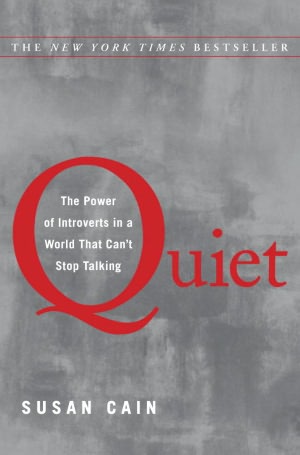
The Power of Introverts
Our culture does not appreciate quiet. We tend to equate social power with social prowess. The outspoken people seen are as the leaders in our culture. Susan Cain, however, seeks to dispel this notion that people with a quiet nature cannot be major influencers or leaders. She opens her book Quiet by discussing one of the most influential figures in the civil rights movement. Rosa Parks made an impact in the civil rights movement through her quietness. She chose to take a quiet stand instead of being outspoken. In doing so, she became a symbol of strength in the movement. This is the first of many examples of introverts that Cain offers to show the power of quiet in a world that likes to talk.
Quiet is Cain’s attempt to prove that, despite America’s preference to extroversion, introverts can be extremely successful and influential in our culture. She begins by discussing the “Extroverted Ideal.” Since the time that Andrew Carnegie taught us how to win friends and influence people, the ideal personality has be extroverted. In the world of business and leadership, the way to get ahead is to speak up and stand out. Cain visits Harvard Business School to understand how they teach students to succeed in business. It becomes very clear that Harvard teaches their students to speak up or they won’t succeed. The issue that Cain finds, however, is that in all their talking, people aren’t listening. In this first part of the book, Cain poses the question of whether or not the extroverted ideal is really ideal. What she finds is people being trained to talk the most, whether they are educated or not, in order to get ahead (see my post on The Introvert in the Boardroom). Businesses promote group brainstorming which tends to favor the outspoken. Cain instead shows that often people who quietly, by themselves, and are allowed to think through the problems are more productive and effective that people working together in groups where people are fighting for attention. While the outspoken standout, they are not always bringing success and are often times talking over those who can give good ideas.
The next part of here book looks at the biology and psychology behind introversion. Cain seeks to discover if introversion genetic. This section is much different that the first part of the book, but still interesting. I found this section of the book personally interesting because I read through it going, “Oh, That’s why I am like that.” Introversion and extroversion seems to be built into our brain functions even from birth. It effects the way we think and process information.
The third part of Cain’s book compares our culture with Asian cultures to see if the Extroverted ideal is apparent in all cultures. Cain shows that there are major differences between the two cultures. America sees extroversion as ideal, while Asian cultures see introversion as ideal. One of the primary differences is how success is achieved. Introverted cultures tend to succeed through persistence and perseverance, while extroverted cultures succeed but speaking over others and getting your ideas heard. Cain uses this to show the some of the people we see as successful succeeded because of persistence instead of outspokenness.
Last, Cain discusses living as an introvert and with introverts. She applies what she’s discussed in previous sections to having relationships, working in an extroverted culture, and raising introverted children. This section is a good balance to the rest of the book which is trying to show that extroversion is not the ideal. Cain reminds her readers that sometimes introverts do need to speak up, but should also not lose the good qualities that introversion brings. She also offers very good practical information on how to live in introvert-extrovert relationships and how to raise introvert children.
Quiet: The Power of Introverts in a World that Can’t Stop Talking is a great book. Susan Cain does a good job of presenting how our culture favors extroversion and looks down on introverts. It may seem at first that Cain is trying to say that introverts are better than extroverts, but reading through the whole work she does a wonderful job of challenging introverts to grow in certain areas. She also challenges extroverts to consider the benefits that introverts are able bring. As an introvert myself I most appreciated the second and fourth sections of the book. I was very interested to learn about myself and why I am the way I am. The second section does a good job of explaining many the biological factors of introversion and extroversion. The fourth section is very helpful because of the helpful advice for living with extroverts and raising and teaching introverted children.
I would recommend this book to just about anyone. If you are an introverted, you will find this book very helpful and encouraging. If you are an extrovert, you can learn why your introverted friends are the way they are and how to best interact with them. I would highly recommend this book to anyone in a business situation, this book can be really helpful in learning how to get the most out of the introverts in your office. I would also recommend it to my friends in the ministry along with Adam S. McHugh’s book Introverts in the Church. I hope that Cain’s book will help people change their understanding of introversion. Introversion is not a weakness. There may be areas where introverts are weak, but there are always areas where introverts tend to be stronger than extroverts.
Disclosure of Material Connection: I received this book for free from WaterBrook Multnomah Publishing Group for this review. I was not required to write a positive review. The opinions I have expressed are my own. I am disclosing this in accordance with the Federal Trade Commission’s 16 CFR, Part 255 : “Guides Concerning the Use of Endorsements and Testimonials in Advertising.”
Mar 25, 2010
Being an Introvert in the Church
Some of you know that I am an Introvert. For people who knew me a long time ago, this may be a surprise because I talked way too much. But, as my mom will tell you, sometime in Junior High I started talking less and answering questions with no more than 5 words. This wasn't something I really understood until I was on my internship. When I was faced with full time ministry, I realized how I function and somethings that might stand in my way. My energy level is drained after spending time with people and it is replenished after quiet times spent reading and reflecting. I'm still learning how to balance that so that I can be in ministry. I learned very quickly on my internship that ministry involves relationships, but I didn't know how I was supposed to live in the balance of personal time and people time.
I also took an online test that I was directed to by my internship mentor and it told me that I was an INTJ. It's not the real myers-briggs test, but it's pretty good. Last semester, I took the Myers-briggs test and it confirmed the online test results. After all this, I was still left with the question of what does that mean for me in ministry. How does an introvert function in the highly relational world of ministry? And that's when Lindsay and I saw an add in an IVP magazine for a book. And I like books.
The book is called Introverts in the Church
and it was written by Adam S. McHugh. And as soon as I could get it from the library I did and I read it. It's a fantastic book. It raises a lot of good questions for the church and gives hope to all of us who want to be involved in Church and don't know how to do it. He legitimizes the introverted concerns I have, but also pushes introverts to step out of their comfort zones enough to grow and be stretched.
The fact of the matter is that churches and ministries are often led by and made for extroverts. Often ministry positions are built for extroverts. They are made for people who love people and spend all of their time working crowds, talking to strangers, and evangelizing on street corners (ok, so maybe not that last one). Adam covers all of these topics and works through how introverts can be involved, lead, and even evangelize. I was highly encouraged by this book and now feel like I do have a place in a society that praises extroverted qualities and thinks introverts to be very strange. I would certainly recommend this for any Christian who finds it hard to be an introvert in an extroverted culture. Also, extroverted leaders may want to read this to figure out why some people seem so weird.
So, are you an introvert? What have you found to be hard about being an introvert in the church?
I also took an online test that I was directed to by my internship mentor and it told me that I was an INTJ. It's not the real myers-briggs test, but it's pretty good. Last semester, I took the Myers-briggs test and it confirmed the online test results. After all this, I was still left with the question of what does that mean for me in ministry. How does an introvert function in the highly relational world of ministry? And that's when Lindsay and I saw an add in an IVP magazine for a book. And I like books.
The book is called Introverts in the ChurchThe fact of the matter is that churches and ministries are often led by and made for extroverts. Often ministry positions are built for extroverts. They are made for people who love people and spend all of their time working crowds, talking to strangers, and evangelizing on street corners (ok, so maybe not that last one). Adam covers all of these topics and works through how introverts can be involved, lead, and even evangelize. I was highly encouraged by this book and now feel like I do have a place in a society that praises extroverted qualities and thinks introverts to be very strange. I would certainly recommend this for any Christian who finds it hard to be an introvert in an extroverted culture. Also, extroverted leaders may want to read this to figure out why some people seem so weird.
So, are you an introvert? What have you found to be hard about being an introvert in the church?
Subscribe to:
Posts (Atom)