I started this blog in 2008 as a way to let people know what was going on while I was on my internship. Over the course of the last 5 plus years, it has morphed into a place where I mostly share reviews of new books that I have read with the occasional deep thought thrown into the mix. I have really enjoyed writing it and sharing with you about life and books. The time has come, however, to move on to something a little different. In September of last year, I was hired at Westbrook Christian Church as the Pastor of Adult Connections and Missional Life. This I oversee the adult discipleship ministries at the church. We moved out of the cornfields of central Illinois and up to the Chicago suburbs, which also makes the tagline of my blog incorrect. In light of my new position, I’m making the move to focus my writing on Discipleship and Mission. There will still be some book reviews, but I want to focus more of my effort and time writing about the ministry I am leading.
Thank you for reading this blog and I hope that you’ll take the time to read what I write over at my new site onthegolife.wordpress.com.
Jan 24, 2014
Jan 18, 2014
Jesus vs. Religion

For the most part, I enjoyed Bethke’s book. His writing is very approachable and he’s straightforward about his life and experiences. There were a few times in the early chapters his writing almost came off as an arrogance or pride that he wasn’t like those “religious” people. He of course is not trying to be that way, since that is one of the attitudes he is trying to combat with this book. Also, I felt a little frustrated by the fact that he uses the word religion without ever really defining it. In James 1:27, we find religion being used as an acceptable term and being defined as caring for orphans and widows. I think he would have helped his cause to define how he is using the word religion and how culture uses the word in contrast to this verse. I know what he means, but it’s always important to define the key terms that you are writing about. Overall, I appreciate that his book is down to earth and he is just trying to be an honest and straightforward follower of Jesus. I love the reason that he is writing and the point he is making. While it’s not my favorite book, it is certainly worth and read and will cause you question how you define your faith.
Disclosure of Material Connection: I received this book free from Thomas Nelson through netgalley.com. I was not required to write a positive review. The opinions I have expressed are my own. I am disclosing this in accordance with the Federal Trade Commission’s 16 CFR, Part 255 : “Guides Concerning the Use of Endorsements and Testimonials in Advertising.”
Sep 25, 2013
A Spiritual Biography of C.S. Lewis

Devin does in fact do what he set out to do. He chronicles the spiritual development of Lewis into and out of Atheism. If you are familiar with Lewis's autobiography Surprised By Joy, much of the first half of this book will be familiar to you. It almost reads like a commentary on Surprised By Joy. Of course, being an autobiography, Lewis's own work does not give the complete picture of his life and Brown's work does. While some might not see this as beneficial, since the beginning of this book is largely based of Lewis's own writing, Brown's work is really helpful for those who want to explore the life of Lewis and how it impacted is writing. While he relies heavily on Surprised By Joy, Brown also works in connections to the other writings of Lewis. He shows how Lewis's own experiences impact the events of the Chronicles of Narnia and the Space Trilogy.
I really enjoyed reading this biography. While many biographies are really thick and full of seemingly unending details, this one had a specific purpose which makes it much more accessible for the person who would like to know more about the life of C.S. Lewis without taking the time to read a hefty book. I also thought the purpose of this biography was beneficial to its subject. The spiritual development of Lewis's life has a great impact on all the works that he wrote both fiction and non-fiction and knowing that brings a greater depth to his books. If you are a fan of C.S. Lewis, you should take some time to read this work. You will have a greater appreciation for the books of this beloved author.
Disclosure of Material Connection: I received this book free from Brazos Press through netgalley.com. I was not required to write a positive review. The opinions I have expressed are my own. I am disclosing this in accordance with the Federal Trade Commission’s 16 CFR, Part 255 : “Guides Concerning the Use of Endorsements and Testimonials in Advertising.”
Aug 1, 2013
Millennials in the Church

In his book You Lost Me, David Kinnaman, president of the Barna Group, reveals research about how Millennials who grew up in the church are leaving the church. According to Barna's research, "Over half of Millennials with a Christian background (59%) have, at some point, dropped out of going to church after having gone regularly, and half have been significantly frustrated by their faith." There are many different reasons, but the reality is they are leaving. Kinnaman's book explores all the reasons why Millennials are say they are leaving, some of which Evans discusses in her article on CNN.
Whatever the reasons, this is a topic that needs to be discussed in the church. My generation is not satisfied with what they are finding. I don't think Millennials are right on every point, but good questions are being raised. If you are a church leader, please take some time to engage the Millennials in your church. If you don't, you may lose most of them for good.
Other posts to check out:
Why Millennials Are Leaving the Church: A Response to Rachel Held Evans
How to keep Millennials in the church? Let’s keep church un-cool.
The Church Failed Millennials, Just Not In the Way You Think It Did
Rearranging the Chairs and other wastes of time: A response to Rachel Held Evans
The Real Secret of Keeping Millennials in the Church
Young Evangelicals are switching to high churches
Three Spiritual Journeys of Millennials
More on millennials and the future of Christianity...(a list of resources & conversations)
Jul 31, 2013
Discipleship and Following Jesus

One of the main issues in the American churches these day is what it means to be a disciple. Many of the conferences being held and books being published are on about discipleship and how to become a disciple who makes disciples. Among those vocal about discipleship, David Platt is probably the most popularly known because of his books about being a "radical" follower of Jesus. His recent book Follow Me is similar in message to his Radical books, but is more specifically focused on discipleship.
If you've heard Platt speak recently, you're probably familiar with the message of this book. Essentially, it boils down to the idea that many Christians are either being deceived or deceiving themselves when it comes to being a real disciple/follower of Jesus. Many people think they are Christians because they prayed a prayer or were baptized. After that, however, they are not changing their lives to look like Christ. They continue on with their life the way it was before. To become a follower of Christ means that your life is different than it was before.
I believe that this is a message that Christians need to hear. Being a disciple is not only about making the decision to follow Christ, but also about actually following him. Much like in Radical, Platt is not afraid to be brutally honest about how Christians are living and how they should be living. He urges us to follow through with our commitment of being a disciple and live up to the call to deny ourselves, take up our cross, and follow Christ.
That being said, the majority of this book is brutal honesty and primarily about what we are doing wrong. What he writes is needed, but while reading the the book it seemed like it was written against what is happening and not for what could be happening. There is discussion of what needs to happen in the last few chapters, but it felt out of balance. In his discussion of what we are doing wrong, I believe he is right in calling us to reexamine some of these potentially harmful practices that we have adopted.
Even though it is a bit harsh, Follow Me is still a very good book and gives us a needed reminder that following Christ does not end at baptism. Christ calls us to more than just a decision to accept his forgiveness. He asks us to follow him and tell others about him.
Disclosure of Material Connection: I received this book free from Tyndale House Publishers through netgalley.com. I was not required to write a positive review. The opinions I have expressed are my own. I am disclosing this in accordance with the Federal Trade Commission’s 16 CFR, Part 255 : “Guides Concerning the Use of Endorsements and Testimonials in Advertising.”
Jul 3, 2013
God's Favorite Place on Earth

Overall, this is a very interesting book. It approaches scripture in a faithful manor, but asks us to look at it from a different angle. It's not the typical way of interacting with the biblical story. I enjoyed seeing if from a different perspective. Through is different perspective, we see that there is more to each story than meets the eye. Even though it's different, he does his best to retell the story in a manor faithful to scripture combined with the best scholarly research about the stories that he retells. Whether Viola's story from Lazarus' perspective is entirely accurate or not, it is compelling. I believe that seeing scripture from a different angle like Viola has done, allows us to reencounter texts that we have read so many times with a new perspective.
I would recommend reading this book. It would be a great supliment to a personal Bible study or a group bible study. Viola even recommends this book to groups for study. The only caution I would give is that the middle chapters of this book are lengthy. For some, it would be no problem to read this over the course of a week, for others the length of the chapters might be difficult. I even found them to be a bit wordy. I think that in some places, it could have been shorter. Aside from the length, however, this is a fascinating read that will help you to interact with familiar scriptures in a new way.
Disclosure of Material Connection: I received this book free from David C. Cook through netgalley.com. I was not required to write a positive review. The opinions I have expressed are my own. I am disclosing this in accordance with the Federal Trade Commission’s 16 CFR, Part 255 : “Guides Concerning the Use of Endorsements and Testimonials in Advertising.”
Jun 10, 2013
Exploring Narnia
Originally published on Englewood Review of Books.
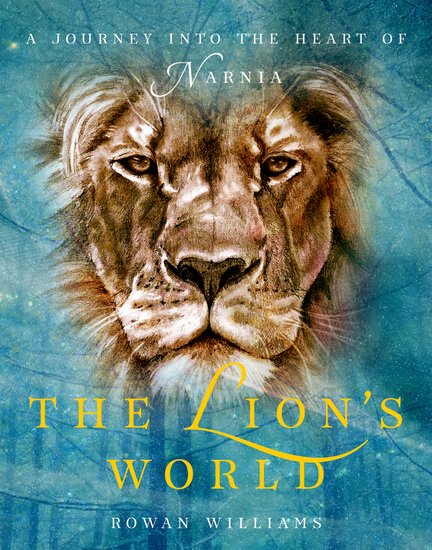 Review of The Lion’s World: A Journey Into the Heart of Narnia by Rowan Williams
Hardback: Oxford UP, 2013
Buy now: [ Amazon ] [ Kindle ]
Recently, while discussing the role of fictional stories in spiritual formation with my students, I found myself returning to the works of C.S. Lewis as an example. While I did not discuss The Chronicles of Narnia, I can undeniably say that the fictional works of Lewis have shaped me spiritually. From a young age, I have read and reread the Narnian stories. They have become a part of my spiritual formation and of many others as well. Lewis has had this effect on Rowan Williams, former Archbishop of Canterbury, as well. He also confesses to repeatedly reading and studying the Lewis’ works and writes of Lewis, “He is someone that you do not quickly come to the end of – as a complex personality and as a writer and thinker” (xi). In The Lion’s World, Williams explores this complexity of Lewis in conjunction with the depth of the Land of Narnia that Lewis created. He doesn’t set out to “decode images or to uncover a system;” instead he aims “to show how certain central themes hang together – a concern to do justice to the difference of God, the disturbing and exhilarating otherness of what we encounter in the life of faith” (6).
Williams begins by discussing Lewis’s intent for writing Narnia. Lewis realized that he lived in a culture that thought they knew what Christianity was all about and denied it, without actually knowing what they denied. He found that he was, “dealing with a public who thought they knew what it was they were disbelieving when they announced their disbelief in Christian doctrine” (17). It was a culture that believed they knew what they were against because it was a part of their culture. Because of this, Lewis wrote fiction to help his readers engage with religion without religious speak. “He wants his readers to experience what it is that religious (specifically Christian) talk is about, without resorting to religious talk as we usually meet it” (19). Lewis attempted to make world where we can encounter the Christian story in a strange new way, specifically a world aimed at children. This strange encounter with the Christian story is what Lewis called “mouthwash for the imagination.” Williams writes that, “The point of Narnia is to help us rinse out what is stale in our thinking about Christianity – which is almost everything” (28).
Chapter 2 is a brief look at the criticisms of Lewis’s work. The three main critiques of Lewis are racial stereotyping, sexism, and violence. In addressing the critiques, Williams both defends and accuses Lewis in his writing. Essentially, there are faults in Lewis, but if we faithfully read Lewis’ work, but he is certainly not one sided in these areas of criticism. While he portrays violence, he is certainly not unashamedly for it. While may show women in an old fashioned light, his stories are not without their strong women. While these things exist in his work, it is important to remember what culture Lewis came out of and see that in fact there are times when he is against those things of which he is accused. Williams sums it up like this, “In short, Lewis is indisputably a writer whose instinctive – and sometimes quite deliberate – attitudes to women and ethnic ‘others’ are abrasive for most contemporaries. But – as with any pre-modern writer – what is interesting is not how Lewis reflects the views of an era but how he qualifies or undercuts them in obedience to the demands of a narrative or a spiritual imperative or both” (45-46).
After the critiques, Williams moves on to a more in depth look at the lion himself. In The Lion, the Witch and the Wardrobe, Aslan comes the “rightful king of Narnia, but he makes his first appearance as a rebel against the established order” (50). He destroys the endless winter of the witch. Again, in Prince Caspian, Aslan is, in a more pronounced way, connected with conspiracy and revolt. Williams suggests Lewis, “is introducing us to a God who, so far from being the guarantor of the order that we see around us, is its deadly enemy” (50). This likely comes out of Lewis’s childhood. While growing up, Lewis was angry at God for making a world filled with suffering. In Narnia, however, Aslan is the one who delivers us from, “Tyranny and suffering and above all the dreary dictatorship of unthinking and bullying power” (51).
Not only does Lewis present this vision of God rebelling against the tyranny of the world, but meeting him always evokes great joy and pleasure. And while he is good and to be enjoyed, but it is never forgotten in Narnia that he is not a tame lion and one must accept him as he is. Lewis presents Aslan as being unashamed of who he is and impossible to change. “Aslan cannot make himself other than he is; he cannot make saltwater fresh, and if we elect to drink saltwater, he cannot make the consequences other than they are” (68).
Chapters 4 and 5 describe how personally interacting with Aslan affects someone. Aslan interacts redemptively with different individuals throughout the Narnian stories. The key to his interactions is how personal Aslan is and how he helps individuals see their part in the story and how Aslan is working in their life. Aslan does not want someone to be concerned with how he is working in another’s life, but wants to reveal how he is working in that person’s life. We each have a part in the story, and Aslan is giving the chance to make amends and fix our mistakes. It is very difficult for all those who are confronted by Aslan. Some who are confronted, like Lucy in Voyage of the Dawn Treader, are willing to repent. Others are choose not to accept the truth like the dwarfs in The Last Battle. Only in meeting Aslan, however, can the truth be revealed and understood.
In his final chapter, Williams explores the depths of Aslan’s country. At the end of the Chronicles of Narnia, the characters find themselves stepping out of Narnia and into Aslan’s country. A place that they can only described as a more real version of Narnia. It is a deeper and more vivid version of the world that we know. “Everything we know is a copy of ‘something in Aslan’s real world’, England no less than Narnia. So the further we go into Aslan’s world, the more vivid becomes our apprehension of what has mattered in our own world” (116-117). Lewis shows us that the end of all things does not end all things, but instead the beginning of the real reality. Death is not the end and neither is the end of the universe, instead it is beginning of real life in Aslan’s country.
Rowan Williams does an amazing job of exploring the depths of Narnia and unpacking the story the Lewis uses us to teach children and adults about the Christian story. In his conclusion, Williams rightly surmises, “The reader is brought to Narnia for a little in order to know Aslan better in this world” (144). There is so much more that could be said about this book, but if you love Narnia and want to explore the depths even more, I would highly encourage you to read this book. Although at times Williams speaks on an academic level about Narnia, the message of Rowan Williams’s The Lion’s World is clear and will benefit anyone who loves the Chronicles of Narnia. After reading The Lion’s World, I want to go and experience the world of Narnia all over again.
Hardback: Oxford UP, 2013
Buy now: [ Amazon ] [ Kindle ]
Recently, while discussing the role of fictional stories in spiritual formation with my students, I found myself returning to the works of C.S. Lewis as an example. While I did not discuss The Chronicles of Narnia, I can undeniably say that the fictional works of Lewis have shaped me spiritually. From a young age, I have read and reread the Narnian stories. They have become a part of my spiritual formation and of many others as well. Lewis has had this effect on Rowan Williams, former Archbishop of Canterbury, as well. He also confesses to repeatedly reading and studying the Lewis’ works and writes of Lewis, “He is someone that you do not quickly come to the end of – as a complex personality and as a writer and thinker” (xi). In The Lion’s World, Williams explores this complexity of Lewis in conjunction with the depth of the Land of Narnia that Lewis created. He doesn’t set out to “decode images or to uncover a system;” instead he aims “to show how certain central themes hang together – a concern to do justice to the difference of God, the disturbing and exhilarating otherness of what we encounter in the life of faith” (6).
Williams begins by discussing Lewis’s intent for writing Narnia. Lewis realized that he lived in a culture that thought they knew what Christianity was all about and denied it, without actually knowing what they denied. He found that he was, “dealing with a public who thought they knew what it was they were disbelieving when they announced their disbelief in Christian doctrine” (17). It was a culture that believed they knew what they were against because it was a part of their culture. Because of this, Lewis wrote fiction to help his readers engage with religion without religious speak. “He wants his readers to experience what it is that religious (specifically Christian) talk is about, without resorting to religious talk as we usually meet it” (19). Lewis attempted to make world where we can encounter the Christian story in a strange new way, specifically a world aimed at children. This strange encounter with the Christian story is what Lewis called “mouthwash for the imagination.” Williams writes that, “The point of Narnia is to help us rinse out what is stale in our thinking about Christianity – which is almost everything” (28).
Chapter 2 is a brief look at the criticisms of Lewis’s work. The three main critiques of Lewis are racial stereotyping, sexism, and violence. In addressing the critiques, Williams both defends and accuses Lewis in his writing. Essentially, there are faults in Lewis, but if we faithfully read Lewis’ work, but he is certainly not one sided in these areas of criticism. While he portrays violence, he is certainly not unashamedly for it. While may show women in an old fashioned light, his stories are not without their strong women. While these things exist in his work, it is important to remember what culture Lewis came out of and see that in fact there are times when he is against those things of which he is accused. Williams sums it up like this, “In short, Lewis is indisputably a writer whose instinctive – and sometimes quite deliberate – attitudes to women and ethnic ‘others’ are abrasive for most contemporaries. But – as with any pre-modern writer – what is interesting is not how Lewis reflects the views of an era but how he qualifies or undercuts them in obedience to the demands of a narrative or a spiritual imperative or both” (45-46).
After the critiques, Williams moves on to a more in depth look at the lion himself. In The Lion, the Witch and the Wardrobe, Aslan comes the “rightful king of Narnia, but he makes his first appearance as a rebel against the established order” (50). He destroys the endless winter of the witch. Again, in Prince Caspian, Aslan is, in a more pronounced way, connected with conspiracy and revolt. Williams suggests Lewis, “is introducing us to a God who, so far from being the guarantor of the order that we see around us, is its deadly enemy” (50). This likely comes out of Lewis’s childhood. While growing up, Lewis was angry at God for making a world filled with suffering. In Narnia, however, Aslan is the one who delivers us from, “Tyranny and suffering and above all the dreary dictatorship of unthinking and bullying power” (51).
Not only does Lewis present this vision of God rebelling against the tyranny of the world, but meeting him always evokes great joy and pleasure. And while he is good and to be enjoyed, but it is never forgotten in Narnia that he is not a tame lion and one must accept him as he is. Lewis presents Aslan as being unashamed of who he is and impossible to change. “Aslan cannot make himself other than he is; he cannot make saltwater fresh, and if we elect to drink saltwater, he cannot make the consequences other than they are” (68).
Chapters 4 and 5 describe how personally interacting with Aslan affects someone. Aslan interacts redemptively with different individuals throughout the Narnian stories. The key to his interactions is how personal Aslan is and how he helps individuals see their part in the story and how Aslan is working in their life. Aslan does not want someone to be concerned with how he is working in another’s life, but wants to reveal how he is working in that person’s life. We each have a part in the story, and Aslan is giving the chance to make amends and fix our mistakes. It is very difficult for all those who are confronted by Aslan. Some who are confronted, like Lucy in Voyage of the Dawn Treader, are willing to repent. Others are choose not to accept the truth like the dwarfs in The Last Battle. Only in meeting Aslan, however, can the truth be revealed and understood.
In his final chapter, Williams explores the depths of Aslan’s country. At the end of the Chronicles of Narnia, the characters find themselves stepping out of Narnia and into Aslan’s country. A place that they can only described as a more real version of Narnia. It is a deeper and more vivid version of the world that we know. “Everything we know is a copy of ‘something in Aslan’s real world’, England no less than Narnia. So the further we go into Aslan’s world, the more vivid becomes our apprehension of what has mattered in our own world” (116-117). Lewis shows us that the end of all things does not end all things, but instead the beginning of the real reality. Death is not the end and neither is the end of the universe, instead it is beginning of real life in Aslan’s country.
Rowan Williams does an amazing job of exploring the depths of Narnia and unpacking the story the Lewis uses us to teach children and adults about the Christian story. In his conclusion, Williams rightly surmises, “The reader is brought to Narnia for a little in order to know Aslan better in this world” (144). There is so much more that could be said about this book, but if you love Narnia and want to explore the depths even more, I would highly encourage you to read this book. Although at times Williams speaks on an academic level about Narnia, the message of Rowan Williams’s The Lion’s World is clear and will benefit anyone who loves the Chronicles of Narnia. After reading The Lion’s World, I want to go and experience the world of Narnia all over again.
Subscribe to:
Posts (Atom)